

Preparing a lesson involves several connected tasks. The teacher needs to set the learning goal, plan the explanation, pick tasks and decide how to check understanding. The materials also have to match the curriculum and the level of a particular class.
Generative AI can help with this. But getting a standalone explanation or a list of questions is not enough: what matters is assembling them into a coherent lesson where the tasks and assessment are tied to the learning goal.
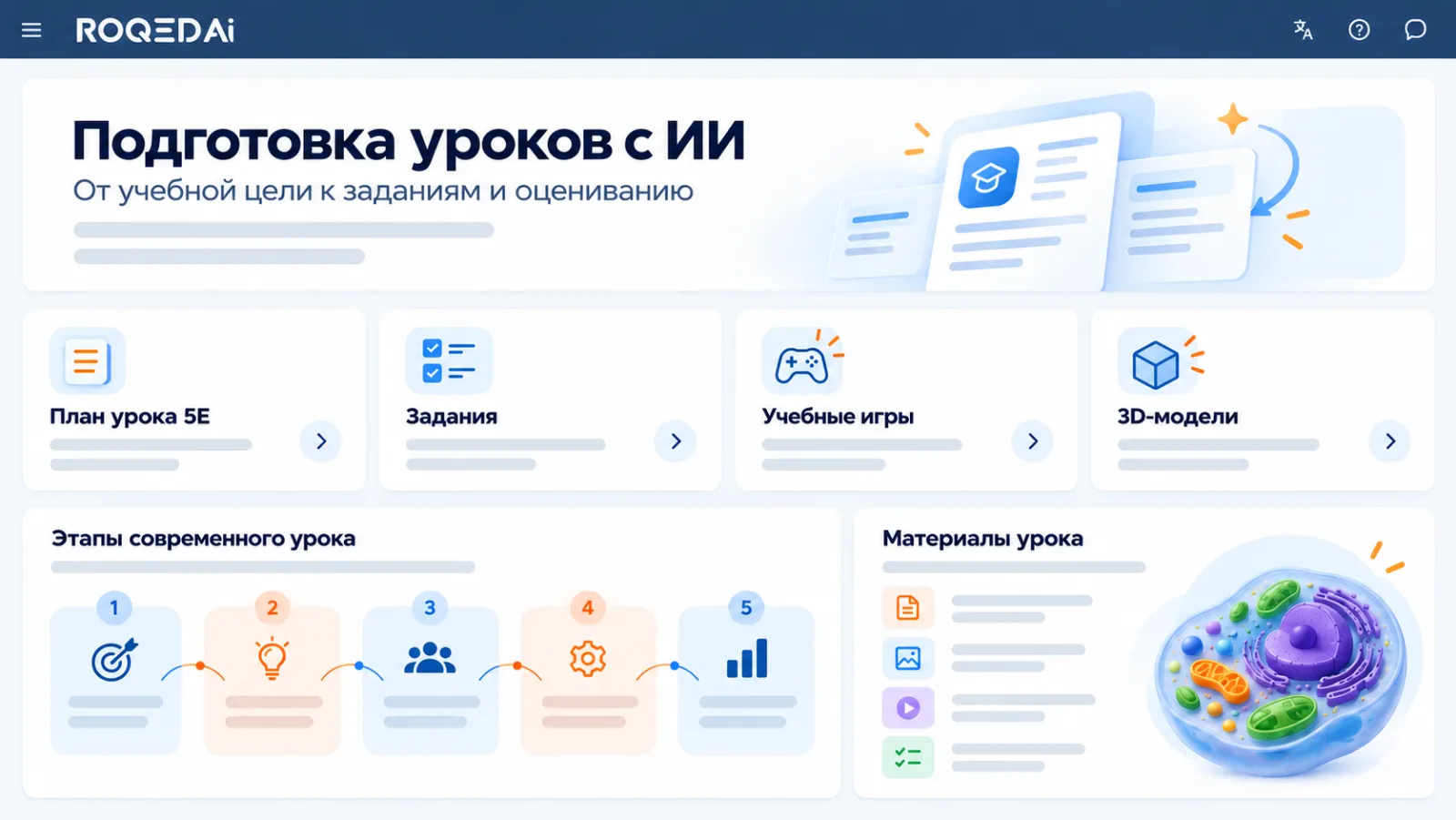
This approach is used in ROQED AI, an AI assistant for teachers developed by ROQED. The platform brings together 5E lesson planning, creating tasks and learning games, and a library of 3D models for visual explanation. ROQED AI is adapted to Kazakhstan's national curriculum and works in Kazakh and Russian.
The lesson plan: from a topic to a sequence of steps
The 5E model structures a lesson in five stages:
Engage: spark interest and find out what students already know.
Explore: offer an observation, experiment or problem for students to investigate.
Explain: go over the results and introduce the key concepts.
Elaborate: apply the knowledge in a new situation.
Evaluate: check how far the learning goal has been reached.
In ROQED AI this model is the basis of the planner. The teacher sets the topic, gets a draft plan and refines it for the time available, the materials at hand and the needs of the class.
For example, a lesson on cell structure can begin with the question of what all living things have in common. Students then examine a model, find the main structures, discuss their functions and complete a task comparing plant and animal cells. At the end, check whether they can explain how the structure of each part relates to its function.
Tasks: check exactly what was taught
When generating tasks, it is important to consider not just the topic but the expected outcome. Naming a part of the cell, explaining its function and comparing two types of cells are different levels of working with the material.
The task builder helps prepare the basis for exercises. The teacher checks the wording, the correctness of the answers and the difficulty, then chooses the tasks that suit their class.
A useful rule for checking: for every task it should be clear which knowledge or skill it lets you assess. If the learning goal requires an explanation, a single question on recognising a term is not enough.
Learning games and 3D models: use them for a specific purpose
The learning game generator lets you prepare material for engaging students and reinforcing knowledge. Games are worth including where they help review concepts, make connections or check understanding.
The 3D model library adds visual objects to the explanation. This format helps when students need to picture a spatial structure or look at an object from different sides.
Work with a model is best paired with a question or task: find an element, compare structures, explain how they are arranged. This keeps students focused on the content of the lesson.
Why adapting to Kazakhstan's curriculum matters
With general-purpose AI tools, the teacher has to spell out the context separately: the grade, the learning goal, the language and the curriculum requirements.
Adapting an educational AI assistant to Kazakhstan's curriculum lets it take the local learning context into account when preparing materials. Working in Kazakh and Russian also matters for schools with different languages of instruction.
Even so, fit with the specific learning goal, correct terminology and text quality must be checked before use in class.
What stays with the teacher
AI prepares options; the teacher makes the teaching decisions. It is the teacher who knows which topics the class finds hard, how long a discussion will take and who will need extra support.
Before the lesson, check:
whether the material matches the learning goal;
whether the facts, terms and answers are correct;
whether students will understand the instructions;
whether the tasks are within the class's reach;
whether the plan is realistic in terms of time;
whether the final task actually checks understanding.
Building ROQED AI shows which tasks can be combined in one educational tool: planning, preparing tasks, game activities and choosing visual materials. The practical value of this approach is being able to work on them as parts of a single lesson, while the teacher keeps control over content and method.
First published on the ROQED blog at Astana Hub: astanahub.com