
What is the biuret test for protein?
The biuret test is a simple chemical test in which an alkaline solution of copper(II) sulfate turns from blue to violet when it is mixed with a sample that contains proteins or peptides.
By the ROQED Science team · Published · Updated
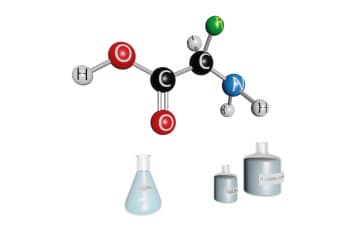
What does the biuret test show?
The biuret test tells you whether a solution contains protein. It does not tell you which protein is present, only that peptide bonds are there.
Proteins are long chains of amino acids joined by peptide bonds. The biuret reagent reacts with these bonds, not with the side chains of individual amino acids. That is why free amino acids on their own give a negative result, while proteins and longer peptides give a positive one.
The test gets its name from biuret, a small compound made by heating urea. Biuret contains bonds similar to peptide bonds and gives the same violet colour.
How do you carry out the biuret test?
A typical school method uses two solutions: sodium hydroxide and dilute copper(II) sulfate. Some labs use a ready-mixed biuret reagent instead.
- Put about 2 cm³ of the sample solution in a clean test tube.
- Add an equal volume of sodium hydroxide solution and mix.
- Add a few drops of dilute copper(II) sulfate solution and shake gently.
- Leave the tube for a few minutes and note the colour.
Always run a control tube with water instead of the sample, so you can compare colours. Sodium hydroxide is corrosive, so wear eye protection and follow your school lab rules.
What do the colours mean?
| Colour after mixing | Meaning |
|---|---|
| Blue | No protein detected (negative) |
| Lilac to purple or violet | Protein present (positive) |
| Pink | Short peptides present |
The blue colour comes from copper(II) ions in the reagent. In alkaline conditions these ions form a complex with the nitrogen atoms of peptide bonds, and that complex absorbs light differently, so the solution looks violet. A deeper colour usually means more protein, which is why the same reaction is used in laboratories as a protein assay with a colorimeter.
Which foods give a positive biuret test?
Egg white, milk, meat extracts, beans and lentils all turn the reagent violet. Starchy foods such as potato, or pure sugar and oil, stay blue. In a food tests practical the biuret test is usually done alongside other tests:
- iodine solution for starch
- Benedict's test for reducing sugars
- the emulsion test for lipids
Together these show which nutrients a food contains. A related practical shows the presence of proteins in different biological objects, such as seeds and tissues.
Common mistakes and misconceptions
- Too much copper sulfate. Adding a lot of blue reagent can hide a weak violet colour. Use only a few drops.
- Expecting a precipitate. A positive result is a colour change in the solution, not a solid.
- Thinking it measures amino acids. Single amino acids do not react; the test needs at least two peptide bonds.
- Skipping the control. Without a water control it is hard to judge pale lilac against blue.
The test works for both globular and fibrous proteins, because all of them contain peptide bonds.
Studying the biuret test with the 3D model
This model is part of the ROQED Science library, a program for natural science lessons with more than 1200 interactive 3D models and courses. In Study mode you can rotate the scene and look at the equipment from any side, and the labelled parts come with short descriptions. Practice mode asks the learner to point out the right steps of an operation, which suits a lab procedure like this one.
Ideas for a lesson:
- Before a real practical, ask students to put the steps in order and explain why the control tube is needed.
- Ask: why does a solution of free amino acids stay blue while egg white turns violet?
- Compare this page with the model of the biuret test on protein solutions and discuss how the colour relates to protein structure.
Frequently asked questions
What is a positive biuret test?
A positive result is a change from blue to lilac, purple or violet. It shows that the sample contains protein or peptides.
What reagents are used in the biuret test?
Sodium hydroxide and dilute copper(II) sulfate solution. Some labs use a single ready-mixed biuret reagent that contains both.
Why do amino acids not give a positive biuret test?
The reagent reacts with peptide bonds. A single amino acid has no peptide bond, so the copper ions cannot form the violet complex.
Is the biuret test quantitative?
In school it is used as a yes-or-no test. In laboratories the strength of the violet colour is measured with a colorimeter to estimate how much protein a sample contains.