
What is an overhead projector (OHP)?
An overhead projector (OHP) is a device that shines a bright light up through a transparent sheet lying on its glass top and uses a lens and mirror above it to throw an enlarged image onto a screen or wall.
By the ROQED Science team · Published · Updated
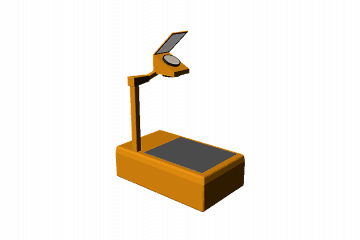
How does an overhead projector work?
The teacher places a transparent plastic sheet, called a transparency or foil, on the flat glass top of the projector. A strong lamp inside the box shines light upward through the sheet.
Above the glass, on an arm, sits the projection head. It holds a lens and a tilted mirror. The lens collects the light that has passed through the sheet and forms a real, enlarged image. The mirror turns the light by about 90 degrees so it travels forward to the screen instead of up to the ceiling. Moving the head up or down focuses the image. The light path relies on refraction at lens surfaces and on reflection from the mirror.
Parts of an overhead projector
- Lamp: a bright bulb, often a halogen lamp, with a reflector behind it.
- Cooling fan: removes the heat from the lamp.
- Fresnel lens: a flat plastic lens with fine rings, built into the glass stage. It bends the light so it converges on the projection lens.
- Stage: the glass surface where the transparency lies.
- Projection head: the lens and mirror on the arm above the stage.
- Focus knob: moves the head to make the image sharp.
The physics of the image
The projection lens is a converging lens. When an object is placed between one and two focal lengths from such a lens, the lens forms a real, inverted and enlarged image on the far side. The transparency sits in this zone, so the picture on the screen is much larger than the sheet.
The image would normally be upside down, but the mirror flips it. As a result the teacher can write on the sheet facing the class, and the audience sees the text the right way round. Moving the projector further from the screen makes the image bigger but dimmer, because the same light is spread over a larger area.
Overhead projector vs other projectors
| Device | What it projects | How |
|---|---|---|
| Overhead projector | transparent sheets | light passes through the sheet from below |
| Slide projector | small transparent slides | light passes through the slide horizontally |
| Epidiascope | opaque pages and pictures, and slides | reflected light from the page, or light through a slide |
| Digital projector | images from a computer | electronic display and lamp or LED |
The overhead projector was common in schools and offices for decades because the presenter could write or draw on the sheet while facing the audience. Digital projectors and screens have largely replaced it.
Advantages and limits
Advantages: it is simple to use, works with hand-written sheets, and lets you build up a diagram layer by layer by stacking transparencies.
Limits: the image is dimmer than a modern projector in a bright room, the lamp gets very hot, and edges of the picture can show a keystone shape if the screen is not square to the beam. It is one of many optical instruments that use lenses and mirrors to form images.
Studying the overhead projector with the 3D model
The overhead projector model is part of the ROQED Science library, a program for natural science lessons with more than 1200 interactive 3D models and courses. In Study mode you can rotate the projector, look into the projection head from any side and read the labelled, described parts. In Slides mode a teacher can prepare slides and questions.
Activities:
- Ask students to draw the path of light from the lamp to the screen and mark where it refracts and where it reflects.
- Discuss why the image would be upside down without the mirror.
- Compare the OHP with the slide projector and epidiascope models.
Frequently asked questions
What is an OHP projector?
OHP stands for overhead projector. It projects images from transparent sheets placed on a lit glass surface.
Why is it called an overhead projector?
The lens and mirror sit above the glass stage, over the presenter's sheet, and the image is projected over the presenter's head onto the screen behind.
What kind of lens does an overhead projector use?
It uses a flat Fresnel lens under the glass to gather light and a converging projection lens in the head to form the enlarged image.
Are overhead projectors still used?
Some classrooms still have them, but most have switched to digital projectors and interactive displays.