
What is a hydraulic cylinder (hydraulic piston)?
A hydraulic cylinder is a linear actuator in which pressurised liquid, usually oil, pushes a piston along a closed tube so that the piston rod moves out or in with a large, steady force.
By the ROQED Science team · Published · Updated
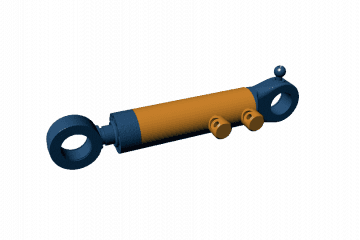
What is a hydraulic cylinder?
A hydraulic cylinder turns the pressure of a liquid into straight-line motion. It is the part of a hydraulic machine that actually does the pushing or pulling: it lifts the arm of an excavator, tips the body of a dump truck or closes the jaws of a press.
People often call the whole unit a "hydraulic piston". Strictly, the piston is only one part of it, the disc that slides inside the tube. The cylinder is the complete device: tube, piston, rod, seals and end caps.
The cylinder does not create pressure itself. A pump pushes oil into it, and valves decide which side of the piston the oil goes to. The cylinder is the output end of the system.
How does a hydraulic cylinder work?
The working principle is Pascal's law: pressure applied to a liquid in a closed container is passed on equally in all directions. Oil is almost incompressible, so when the pump forces oil into one end of the cylinder, the pressure acts on the whole face of the piston and pushes it along.
In a typical double-acting cylinder the piston divides the tube into two chambers.
- Oil is sent into the cap end chamber. The piston moves towards the head and the rod extends.
- Oil from the rod end chamber is pushed out and returns to the tank.
- To retract the rod, a valve reverses the flow: oil goes into the rod end and leaves from the cap end.
The same idea, with a small piston driving a large one, is behind the hydraulic press.
What are the parts of a hydraulic cylinder?
- Barrel. The strong tube that holds the oil and guides the piston.
- Cap (cylinder bottom). Closes one end of the barrel. It often carries a mounting eye.
- Head (gland). Closes the other end. The rod passes through it, and it holds the rod seal.
- Piston. A disc that slides inside the barrel and separates the two chambers. It carries seals and guide rings so oil cannot leak past it.
- Piston rod. A polished steel rod fixed to the piston. It comes out of the head and transfers the force to the load.
- Seals and wiper. Keep oil in and keep dirt out of the cylinder.
- Ports. Openings where the oil lines connect.
The piston of a hydraulic cylinder looks similar to an engine piston, but the job is reversed. In an engine, expanding gas pushes the piston. In a hydraulic cylinder, a pump pushes the liquid.
How much force can a hydraulic cylinder produce?
The force depends on two things: the oil pressure and the area it acts on.
Force = pressure × piston area
Doubling the pressure doubles the force. Doubling the piston diameter gives four times the area, and so four times the force at the same pressure. This is why heavy machines use cylinders with wide pistons.
The pushing force and the pulling force are not equal. On the rod side, part of the piston face is covered by the rod, so the oil acts on a smaller ring-shaped area. A double-acting cylinder therefore pushes harder than it pulls, and it retracts faster for the same oil flow.
Speed is set by flow, not pressure: the more oil per second the pump delivers, the faster the rod moves.
Types of hydraulic cylinders
| Type | How it works | Typical use |
|---|---|---|
| Single-acting | Oil pushes in one direction only; a spring or the load returns the rod | Car jacks, simple lifts |
| Double-acting | Oil can push the piston both ways | Excavators, loaders, presses |
| Telescopic | Several tubes slide out of each other for a long stroke | Dump truck bodies |
| Plunger (ram) | The rod itself acts as the piston | Heavy presses, lifts |
A related use of hydraulics is braking. In a vehicle brake system the pedal drives a master cylinder, and small slave cylinders press the pads against the disc brakes. The principle is the same, only the cylinders are much smaller.
Where are hydraulic cylinders used?
Hydraulic cylinders are chosen when a machine needs a large force in a compact space and smooth, controllable movement.
- Construction machines: excavators, bulldozers, cranes and loaders.
- Farm machinery: tractor lifting arms and tipping trailers.
- Factories: presses, injection moulding machines and lifting tables.
- Transport: aircraft landing gear, lorry tail lifts and car service lifts.
- Civil engineering: lock gates, movable bridges and jacks for lifting heavy structures.
Every such system also needs a source of flow, such as a water pump in simple setups or an oil pump in machines, and valves like a water valve to start, stop and direct the liquid.
How to study the hydraulic cylinder with the 3D model
The hydraulic cylinder model is in the ROQED Science library, a program for natural science lessons with more than 1200 interactive 3D models and courses. Models have labelled parts with short descriptions.
In Study mode students can rotate the cylinder and look at it from any side to see how the piston sits inside the barrel. Animation mode plays 3D animations with a voiced explanation, and in Slides mode a teacher can build slides and questions around the model.
Classroom ideas:
- Ask students to trace the path of the oil when the rod extends and when it retracts.
- Ask: why does the cylinder push with more force than it pulls at the same pressure?
- Give a pressure and a piston area and have students calculate the force, then compare it with the weight of a car.
Frequently asked questions
What is the difference between a hydraulic cylinder and a hydraulic piston?
The piston is the sliding disc inside the cylinder. The hydraulic cylinder is the whole device, including the barrel, rod, seals and end caps, although many people use the two names for the same thing.
What liquid is used in a hydraulic cylinder?
Most cylinders use hydraulic oil. It is almost incompressible, lubricates the moving parts and protects them from rust. Some systems use water-based fluids where fire risk is a concern.
Why are hydraulic cylinders so strong?
The force equals the oil pressure multiplied by the piston area. Hydraulic systems work at high pressures, so even a cylinder of modest size can produce a very large force.
What makes a hydraulic cylinder single-acting or double-acting?
A single-acting cylinder has oil on one side of the piston only and relies on a spring or the load to return. A double-acting cylinder has ports on both sides, so oil can drive the rod out and back.