
What is a human egg cell (ovum)?
A human egg cell, or ovum, is the female sex cell: a large, round, non-moving cell that carries 23 chromosomes and, when a sperm fertilises it, supplies the cytoplasm and organelles of the new embryo.
By the ROQED Science team · Published · Updated
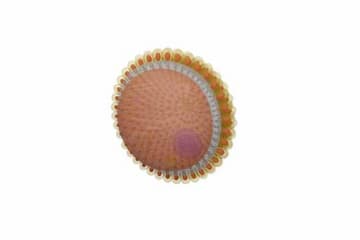
What is an egg cell?
The egg cell is the female gamete. A gamete is a sex cell with half the usual number of chromosomes. Most cells of the human body have 46 chromosomes in 23 pairs. The egg has only one chromosome from each pair, 23 in total, so it is called haploid.
The egg is the largest cell in the human body. It is about 0.1 mm across, roughly the width of a fine hair, and can just be seen without a microscope. It has no tail and cannot move by itself. After it leaves the ovary it is carried along the oviduct by the beating of tiny hairs on the oviduct wall.
The egg is large because it stores what the embryo needs for its first days: nutrients, enzymes and organelles. You can compare its organelles with those of a typical body cell in the model of the structure of plant and animal cells.
What is the structure of an egg cell?
From the outside in, a mature human egg has these parts.
- Corona radiata. A loose outer layer of small follicle cells that came with the egg from the ovary. They supported the egg while it grew.
- Zona pellucida. A thick, clear coat of glycoproteins around the egg. Sperm must bind to it and pass through it.
- Cell membrane. The boundary of the egg itself. It fuses with the membrane of one sperm.
- Cytoplasm. A large volume filled with nutrient stores, ribosomes and many mitochondria. All the mitochondria of the future child come from the egg, which is why mitochondrial DNA is inherited from the mother.
- Cortical granules. Small vesicles just under the membrane. They release their contents after a sperm enters and harden the zona pellucida.
- Nucleus. It holds the 23 chromosomes, one of which is always an X chromosome.
How does an egg cell form?
Egg cells form in the ovaries, which are part of the female reproductive system. The process is called oogenesis. It starts before birth: a baby girl is born with all her immature egg cells already in place, each paused at an early stage of division.
From puberty, usually one egg matures and is released in each menstrual cycle. This release is called ovulation.
The chromosome number is halved by meiosis. In egg formation the cytoplasm is divided very unequally. One cell keeps almost all of it and becomes the egg. The other products are tiny cells called polar bodies, which break down. This way one large, well-stocked egg is made instead of four small cells. The second meiotic division is completed only if a sperm enters the egg.
Egg cell vs sperm cell
The two gametes carry the same amount of nuclear genetic material but are built for different jobs. The egg stores resources and waits. The human sperm cell is built to travel.
| Feature | Egg cell | Sperm cell |
|---|---|---|
| Size | About 0.1 mm, the largest human cell | Far smaller, with a head only a few micrometres long |
| Shape | Round | Head, midpiece and long tail |
| Movement | Cannot move by itself | Swims with its tail |
| Cytoplasm | Large, with nutrient stores | Very little |
| Sex chromosome | Always X | X or Y |
| Number produced | Usually one per cycle | Millions per day |
Because every egg carries an X chromosome, it is the sperm that decides whether the embryo will be XX or XY.
What happens to the egg at fertilisation?
Fertilisation normally takes place in the oviduct. Many sperm reach the egg, but only one enters. The steps are shown in the model of oocyte fertilization.
- Sperm push between the cells of the corona radiata and bind to the zona pellucida.
- Enzymes from the tip of the sperm head help it get through the zona.
- The membranes of the sperm and the egg fuse, and the sperm nucleus enters the egg.
- The cortical granules empty, and the zona pellucida changes so that no further sperm can get in.
- The egg finishes meiosis, and the two sets of 23 chromosomes come together.
The result is a zygote with 46 chromosomes. It begins to divide by mitosis while it moves towards the uterus. The later steps are covered in the stages of development of the embryo and fetus.
Common mistakes about egg cells
A few points regularly cause errors in tests.
- The egg is not diploid. It has 23 chromosomes, not 46. The full set is restored only in the zygote.
- New eggs are not made every month. The immature cells are present from birth. Each cycle, one of them completes its growth.
- The egg does not swim. It is moved by the oviduct.
- The zygote does not get half of everything from each parent. The nuclear chromosomes come equally from both, but the cytoplasm and organelles come from the egg.
- An egg is one cell. Even a bird's yolk is a single giant cell, as the model of an egg shows, although the human egg has far less stored food because the embryo is fed by the mother.
How to study the egg cell with the 3D model
The human egg cell model is in the ROQED Science library, a program for natural science lessons with more than 1200 interactive 3D models and courses. Models have labelled parts with descriptions, so students can connect each name to a place on the cell.
In Study mode you can rotate the egg and view it from any point. In Slides mode a teacher can prepare slides and questions around the model.
Classroom ideas:
- Ask students to name the layers a sperm has to cross, in order, while pointing to each one on the model.
- Open the egg and the sperm models side by side and have students fill in a comparison table of size, shape and contents.
- Ask: why does the egg need so much cytoplasm when the sperm has almost none?
Frequently asked questions
How big is a human egg cell?
A human egg is about 0.1 mm in diameter. It is the largest cell in the human body and is just visible to the naked eye as a tiny dot.
How many chromosomes does an egg cell have?
A human egg cell has 23 chromosomes, half the number found in body cells. One of them is always an X chromosome.
What is the difference between an ovum and an oocyte?
An oocyte is an egg cell that has not yet finished meiosis. The cell released at ovulation is strictly a secondary oocyte, and it completes meiosis to become an ovum only when a sperm enters it. In school texts both are often simply called the egg.