
What is hay bacillus (Bacillus subtilis)?
Hay bacillus, or Bacillus subtilis, is a rod-shaped, Gram-positive soil bacterium that can form tough endospores and is widely used in biology teaching, research and industry.
By the ROQED Science team · Published · Updated
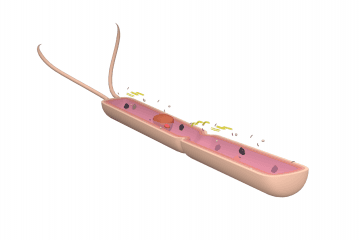
What is hay bacillus?
Hay bacillus is the common name of Bacillus subtilis. It got the name because it was easily grown from an infusion of boiled hay: boiling kills most microbes, but the spores of this bacterium survive and then grow.
It lives mainly in soil and on decaying plant material, and is also found in the gut of animals and humans. For most people it is harmless, which makes it a good model organism. Scientists study it to understand how bacteria grow, divide and form spores.
What is the structure of a Bacillus subtilis cell?
Like all prokaryotes, hay bacillus has no nucleus. Its main parts are:
- Cell wall with a thick peptidoglycan layer, which is why it stains purple in the Gram stain (Gram-positive).
- Cell membrane that controls what enters and leaves.
- Cytoplasm with ribosomes.
- Nucleoid, a region with one circular chromosome.
- Flagella around the cell that let it swim.
You can compare this with the general structure of bacteria and with a eukaryotic cell, which has a nucleus and membrane-bound organelles.
How does hay bacillus form endospores?
When food runs short, a Bacillus subtilis cell can make an endospore. The cell copies its DNA and builds a small, dry, thick-walled body inside itself around one copy. The rest of the cell then breaks down and releases the spore.
An endospore is not a way of reproducing, because one cell gives one spore. It is a resting stage. Spores survive heat, drying, radiation and many chemicals, and can stay dormant for a long time. When conditions improve, the spore germinates and becomes an active cell again.
Why is Bacillus subtilis useful?
- Enzymes. It releases enzymes such as proteases and amylases into its surroundings. Industry grows it in bioreactors to produce enzymes for washing powders and food processing.
- Food. A strain of B. subtilis is used to ferment soybeans into the Japanese food natto.
- Agriculture. Some strains are used to protect plant roots from harmful microbes.
- Research. It is easy to grow and to change genetically, so it is a standard model for Gram-positive bacteria, much as Escherichia coli is for Gram-negative ones.
Hay bacillus vs E. coli
| Feature | Bacillus subtilis | Escherichia coli |
|---|---|---|
| Shape | Rod | Rod |
| Gram stain | Positive | Negative |
| Endospores | Yes | No |
| Usual habitat | Soil, plant material | Gut of warm-blooded animals |
Both are rod-shaped bacteria, but their cell walls differ, and only hay bacillus survives harsh conditions as a spore. Some relatives in the same genus cause disease, so the genus name alone does not tell you whether a species is harmful.
Studying hay bacillus with the 3D model
The hay bacillus model is in the ROQED Science library, a program for natural science lessons with more than 1200 interactive 3D models and courses. In Study mode students can rotate the cell and look at it from any angle, with labelled and described parts. In Slides mode a teacher can prepare slides and questions for the class.
Questions for a lesson:
- Which parts of this cell would you also find in a plant cell, and which would you not?
- Why can boiled hay still grow bacteria after a few days?
- Compare the cell with a virus such as bacteriophage T4, which infects bacteria: is a virus a cell?
Frequently asked questions
Is hay bacillus harmful to humans?
Bacillus subtilis is generally considered harmless to healthy people and is even used in some foods. Like any microbe, it is handled in labs with standard hygiene rules.
Is Bacillus subtilis Gram-positive or Gram-negative?
It is Gram-positive. Its thick peptidoglycan cell wall keeps the purple stain in the Gram test.
Why is it called hay bacillus?
It was easily isolated from boiled hay infusions, where its heat-resistant spores survived and grew while other microbes died.
Is an endospore a form of reproduction?
No. One cell makes one spore, so numbers do not increase. The spore is a resistant resting stage.