
What are examples of reducing sugars?
A reducing sugar is a carbohydrate that can donate electrons to another substance because it has a free aldehyde group or a group that can open into one, and common examples are glucose, fructose, galactose, maltose and lactose.
By the ROQED Science team · Published · Updated
What is a reducing sugar?
In chemistry, a reducing agent gives electrons to another substance and is itself oxidised. A reducing sugar can do this because its molecule has an aldehyde group (-CHO), or a ring that can open to expose one.
In water, sugars such as glucose switch between a ring form and an open-chain form. The open chain carries the reactive group. When it meets a mild oxidising agent, such as copper(II) ions in Benedict's solution, the sugar is oxidised and the copper ions are reduced. This is an example of a redox process. To learn how sugars are grouped, see carbohydrates and their classification.
Examples of reducing sugars
All monosaccharides are reducing sugars.
- Glucose: the main fuel of cells, an aldose with an aldehyde group. Compare its two ring forms in alpha and beta glucose.
- Fructose: fruit sugar, a ketose. Its keto group is not an aldehyde, but in alkaline solution fructose rearranges into a form that reacts, so it gives a positive test.
- Galactose: part of milk sugar.
- Ribose and deoxyribose: five-carbon sugars in RNA and DNA.
Some disaccharides are reducing sugars.
- Maltose: two glucose units, formed when starch is digested.
- Lactose: glucose plus galactose, found in milk.
These disaccharides stay reducing because one of their units still has a free group that can open.
Which sugars are not reducing?
Sucrose, ordinary table sugar, is the classic non-reducing sugar. In sucrose the glucose and fructose units are joined through the very carbon atoms that would form the reactive groups, so neither ring can open. You can see how this link forms in the glycosidic bond model.
Large polysaccharides such as starch and cellulose have only one reducing end in a very long chain, so they give little or no positive result in a normal test.
| Sugar | Type | Reducing? |
|---|---|---|
| Glucose | monosaccharide | yes |
| Fructose | monosaccharide | yes |
| Maltose | disaccharide | yes |
| Lactose | disaccharide | yes |
| Sucrose | disaccharide | no |
| Starch | polysaccharide | no (practically) |
How do you test for reducing sugars?
The usual school test is Benedict's test. Mix the food solution with an equal volume of blue Benedict's reagent and heat it in a water bath for a few minutes.
If a reducing sugar is present, the blue copper(II) ions are reduced to copper(I) oxide, which forms a coloured precipitate. The colour moves from blue to green, yellow, orange and brick red as the amount of sugar increases, so the test is roughly quantitative. Fehling's solution works on the same principle.
To show that sucrose is present, first boil it with dilute acid. This hydrolyses it into glucose and fructose, which then give a positive Benedict's result after the acid is neutralised. Follow normal lab safety: wear eye protection and handle hot water baths with care.
Why reducing sugars matter
Reducing sugars react with amino acids when food is heated, giving browning and flavour in toast, roasted coffee and baked crusts. In the body, glucose can attach to proteins in the blood without enzymes, which is why doctors measure such changes over time. In the lab, the test helps identify the sugars in foods alongside other food tests for starch, proteins and fats.
Studying reducing sugars with the 3D model
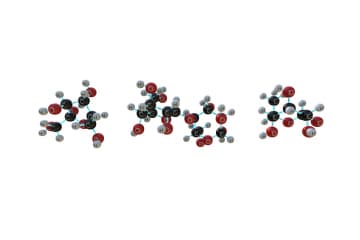
This model of glucose, fructose and maltose molecules is part of the ROQED Science library, a program for natural science lessons with more than 1200 interactive 3D models and courses. In Study mode you can rotate each molecule and see its rings and functional groups from any point of view; parts are labelled and described. Slides mode lets a teacher prepare slides and questions.
Ideas:
- Ask students to find the carbon atom that can open into an aldehyde or keto group in each molecule.
- Compare maltose with sucrose and explain why only one of them is reducing.
- Predict Benedict's test colours for glucose, sucrose and starch before doing the practical.
Frequently asked questions
Is glucose a reducing sugar?
Yes. Glucose has an aldehyde group in its open-chain form, so it reduces Benedict's and Fehling's solutions.
Is sucrose a reducing sugar?
No. The bond between glucose and fructose in sucrose locks both reactive groups, so sucrose gives a negative Benedict's test until it is hydrolysed.
Are all monosaccharides reducing sugars?
Yes. Every monosaccharide has a free aldehyde or keto group that can react under the test conditions.
What colour shows a positive test for reducing sugars?
In Benedict's test the solution changes from blue to green, yellow, orange or brick red, depending on how much reducing sugar is present.